A hazard tree is one that could fail and hit a house, a car, a road or a person. If you have one on a Gold Hill property, call (541) 855-3080 to reach one tree service, a separate business carrying an Oregon CCB license. Three requests to make of it: an in-person look, a plain account of what it found, and an estimate on paper before any work.
This is a free referral service. It does no tree work and does not inspect trees itself. The company you are connected with does the looking, the pricing and the cutting, and you decide whether to go ahead. The rest of this page explains what to look for, what Gold Hill's own code says about dead trees, and how hazard tree removal in Gold Hill usually plays out on a slope, near the river, or on a tight town lot. The home page has an overview of the line.
Signs a tree may be a hazard
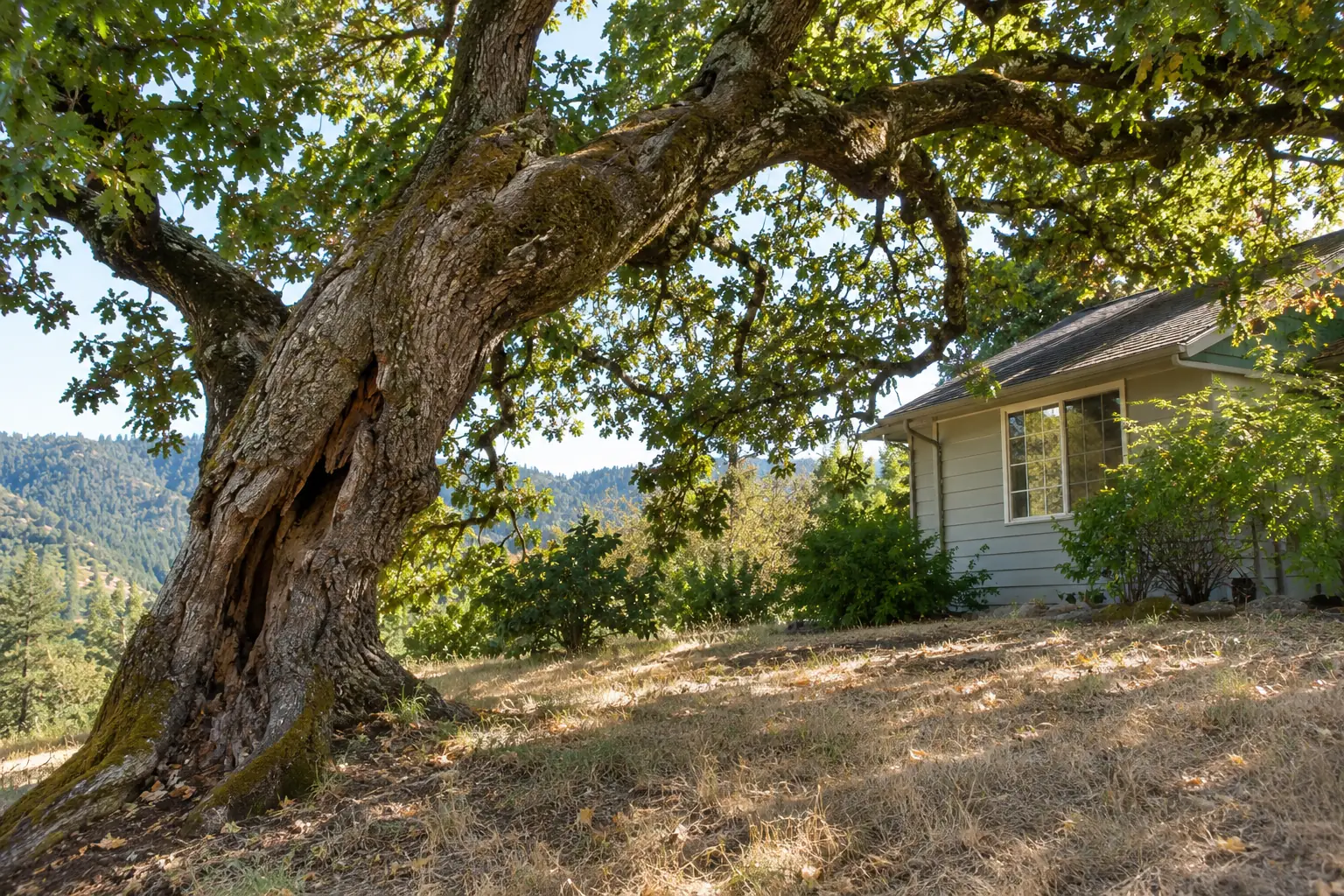
The clearest warning signs are dead wood, cracks, a new lean, and damage at the base or roots. You do not need training to spot most of them. Walk around the tree on a calm day and look up, then down.
Look up for:
- Dead limbs with no leaves or needles when the rest of the tree is green.
- Broken branches hung in the crown, sometimes called hangers.
- A crown that is thin or dying back from the top.
- Two or more large stems joined in a tight V, especially with a crack below the joint.
Look down for:
- Mushrooms or conks growing on the trunk or roots.
- Soil heaved up or cracked on one side of the base.
- A lean that was not there last year.
- Bark falling away in sheets, or hollow sounds when you tap the trunk.
- Roots cut by a trench, driveway or new foundation.
One sign alone does not mean the tree must come down. Several together, over something you care about, is the time to have it looked at. If the tree shows these signs but has not changed in weeks, book a regular visit. The next windstorm is what can make it urgent. If a tree has already fallen or cracked and is about to land on a home, see the emergency tree removal page.
What Gold Hill city code says about dead trees
Gold Hill's code treats a dead or decaying tree that threatens people or property as a nuisance. Section 8.08.100 of the Gold Hill Municipal Code, Title 8 says no owner or person in charge of property shall allow a dead or decaying tree that is a hazard to the public, or to people or property on or near the lot, to stand.
The same section sets clearance over public ways. Branches and other growth may not hang lower than eight feet above a sidewalk or lower than thirteen feet six inches above a roadway. The owner or occupant next to a parking strip is also responsible for growth in that strip.
Title 8 also lays out how the city handles a nuisance, from a notice to abatement, with costs that can become a lien on the property. Rules can change and code is read by the city, not by this site, so call Gold Hill City Hall at (541) 855-1525 with questions. The Gold Hill tree rules guide covers the river setback and county rules as well.
Hazard trees common around Gold Hill
The trees that most often become hazards here are oaks carrying heavy mistletoe, conifers weakened by dry summers, and trees growing on cut banks or slopes. Each fails in its own way.
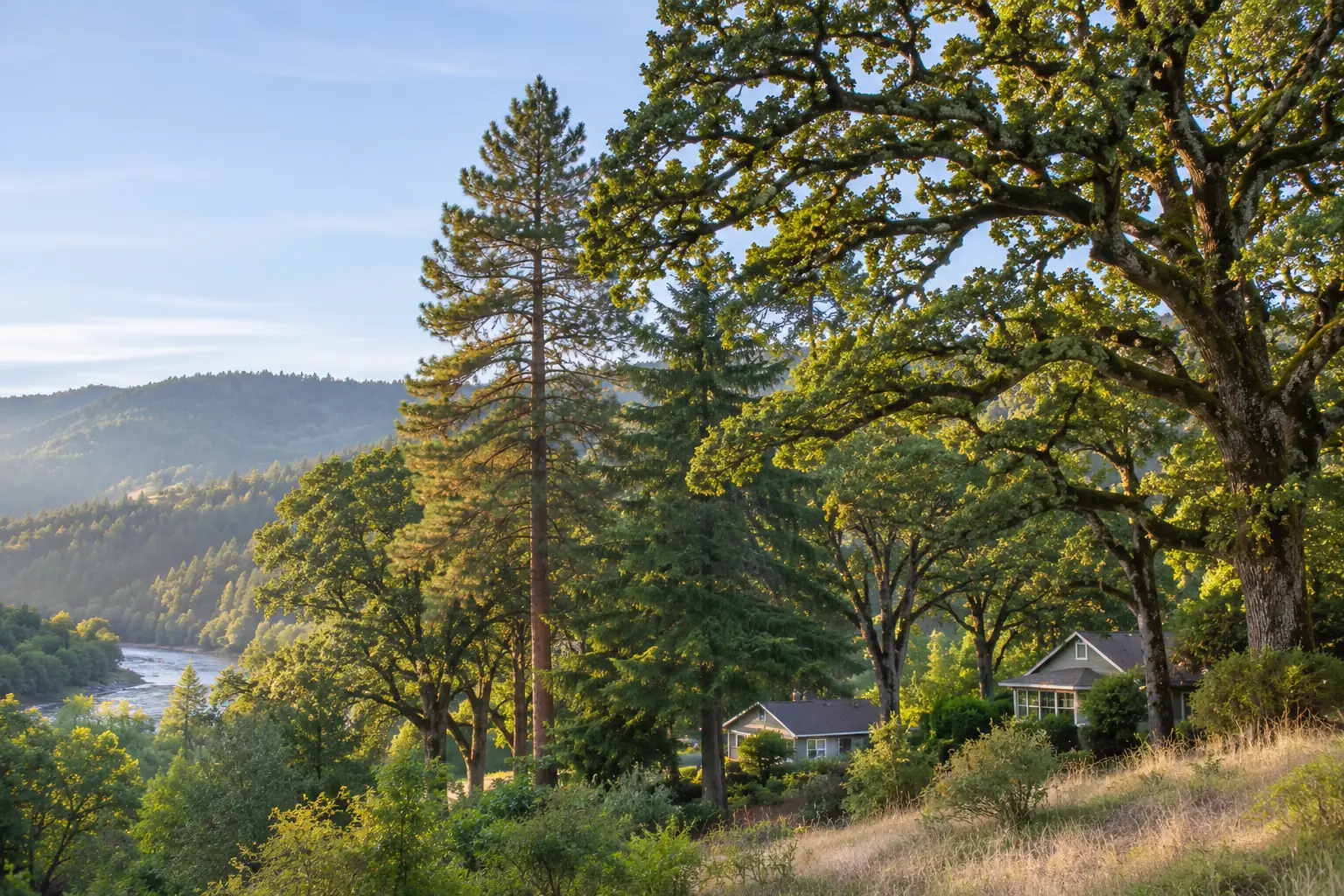
Oaks with mistletoe. Oak mistletoe grows on Oregon white oak and black oak. The Pacific Northwest plant disease handbook, an Extension publication, says branches heavily laden with mistletoe often break off in storms or high winds. OSU Extension notes that the effect on the tree itself is usually small (EM 9679). The risk is the limb, not always the whole tree. The oak tree removal guide goes deeper.
Stressed conifers. Summers here are long and dry, and a stressed fir or pine often shows it first at the top. A conifer that is browning from the crown down, or that has pitch streaming from small holes in the trunk, deserves a closer look from the company.
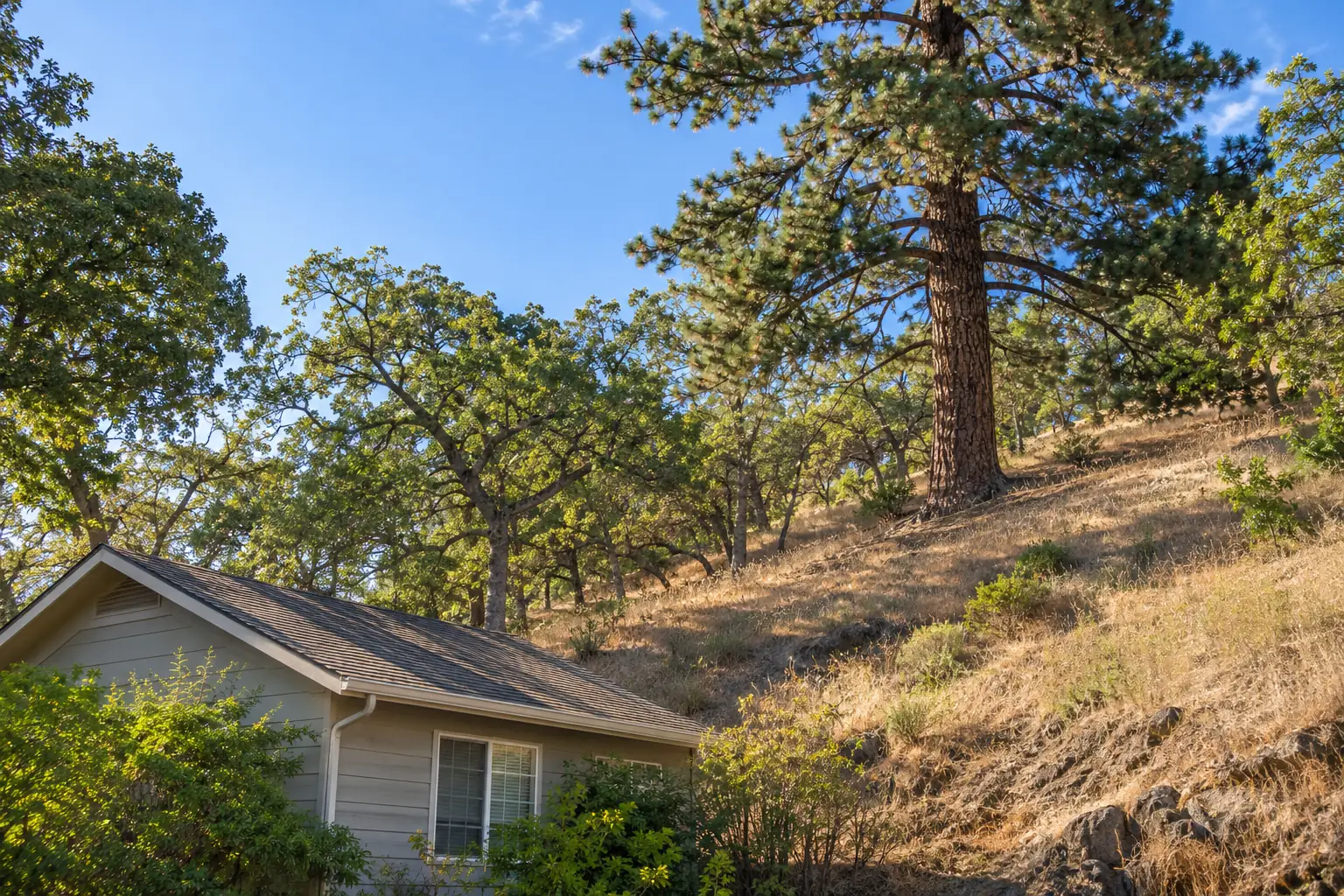
Trees on slopes and cut banks. Many Gold Hill homes sit on hillside lots. A tree whose roots were cut to make a driveway or a level pad can lose its grip, and wet winter soil makes it worse. The hillside tree removal guide covers this.
Who should judge whether a tree comes down
A tree company or a certified arborist should judge a tree you are worried about, because a lot of decay is hidden inside the trunk or roots. When you call (541) 855-3080, find out from the company you reach whether the person sent to look holds the ISA Certified Arborist credential, and whether removal, pruning or leaving the tree alone is its advice.
Ask these questions on site:
- What exactly is wrong with the tree, and where?
- What could it hit if it fails, and in which direction would it likely fall?
- Is pruning a real option, or only a short delay?
- What does the price include: haul-away, wood left in rounds, stump grinding?
- What is your CCB number?
You can check the number on the Oregon CCB license search. Tree removal is licensed work in Oregon, and the Landscape Contractors Board says either a CCB or an LCB license covers it. If you want a second opinion, you are free to get one.
Hazard trees near the Rogue River
A hazard tree within 75 feet of the top of the Rogue River bank sits inside Gold Hill's riparian setback, and that changes what can be cleared around it. City code, Section 17.49.040 of Title 17, says all vegetation and tree cover will be retained within that 75-foot band, with a short list of exceptions. Those exceptions include removing non-native plants under a landscape plan and forestry activity allowed under the Forest Practices Act.
The code does not spell out a hazard tree exception in that chapter. If a tree near the bank is dead or leaning toward a house, call the city before work starts and ask how it wants the removal handled. Keep the stump and roots in place unless you are told otherwise, since roots help hold the bank.
Options short of full removal
Removal is not the only answer for every hazard tree, and a good company will say so. Depending on the defect, the choices can include:
- Removing one dead or cracked limb and leaving the rest.
- Reducing the weight on a long limb that reaches over a roof.
- Cutting out branches loaded with mistletoe.
- Cabling a split stem, where the company judges it sound enough.
- Taking the tree down to a tall stump and leaving the trunk for wildlife, on acreage where nothing is underneath.
The last option suits rural lots. The Oregon Conservation Strategy lists keeping snags among its recommended actions for oak habitat, since cavity-nesting birds use them. On a small lot in town, a standing trunk near a fence or street is usually not practical.
How a hazard tree is usually taken down
A hazard tree is often taken down in pieces rather than felled in one cut, because weak wood does not behave the way a healthy trunk does. A climber or a lift works from the top down, and sections are lowered on ropes. On open acreage with room to fall, the company may fell the tree whole after checking the lean and the hinge wood.
Plan for the cleanup. Ask whether brush is chipped on site, whether logs are hauled or left in rounds, and whether the stump is ground. The stump grinding page explains that last step. If the job falls during fire season, saw hours depend on the daily fire danger level set by the Oregon Department of Forestry, as the fire season tree work guide explains. Costs are covered in the tree removal cost guide.
Frequently asked questions
How do I know if my tree is dangerous?
Look for dead limbs, cracks, a new lean, fungus at the base and lifted soil. Several of these over a house, driveway or play area is a reason to call (541) 855-3080 and have a licensed tree company look.
Will the city make me remove a dead tree?
Gold Hill code treats a dead or decaying tree that is a hazard to people or property as a nuisance, and the city can act on nuisances. Ask Gold Hill City Hall at (541) 855-1525 how it applies to your tree.
Does a hazard tree near the Rogue River need permission to remove?
City code keeps vegetation within 75 feet of the top of the Rogue River bank, with limited exceptions. Call the city before cutting a tree in that band, and ask how it wants a dangerous tree handled.
Is an oak with lots of mistletoe a hazard?
Mistletoe alone does not make an oak a hazard. OSU Extension says it usually has a small effect on the tree, but heavily loaded branches can break in storms. Have the company check the limbs that hang over things you care about.
Can I just prune a hazard tree instead of removing it?
Pruning works for some defects. Removing one dead limb or reducing weight can fix a single defect. If the trunk or roots are decayed, pruning only delays the problem. Ask the company to explain which case your tree is.