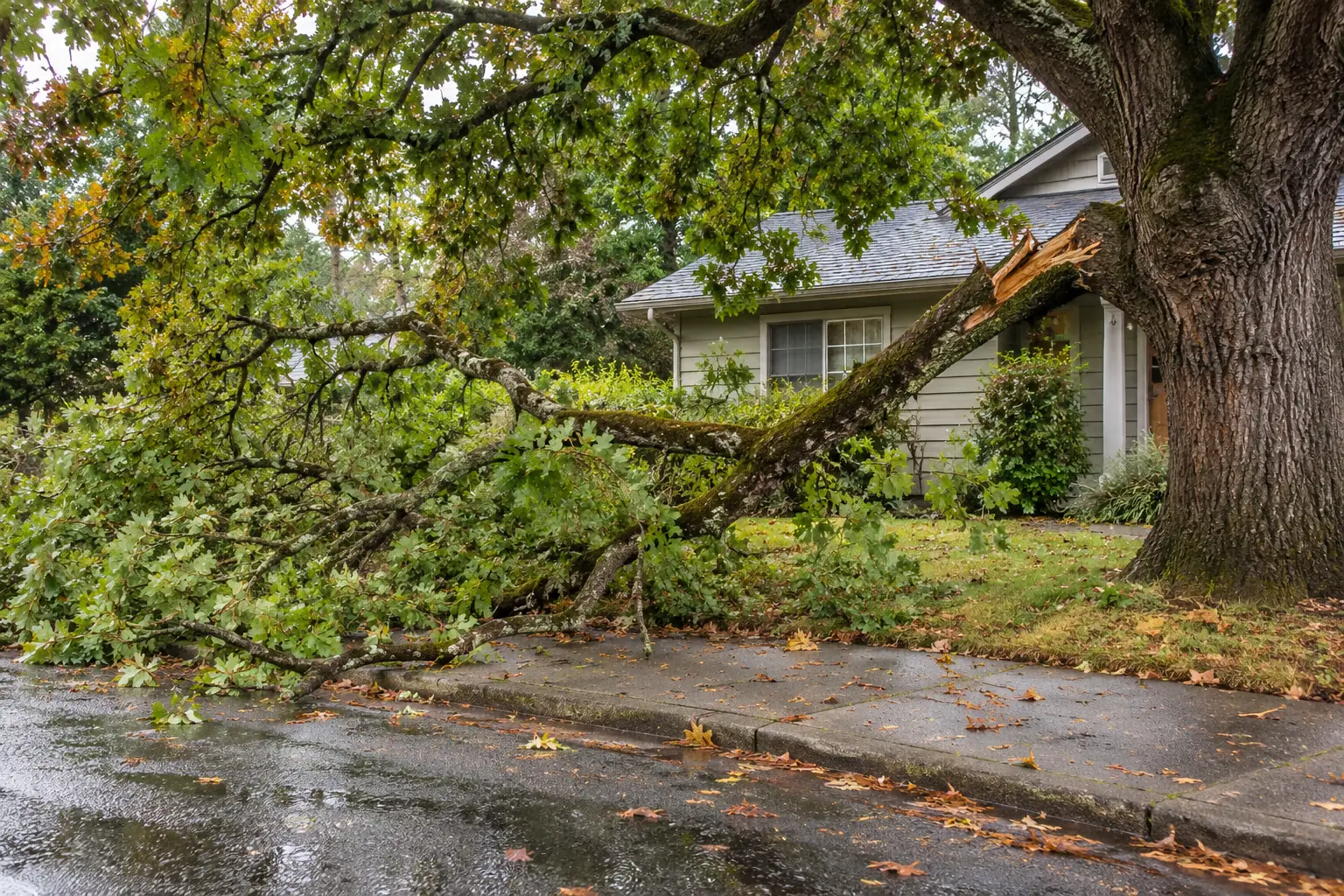
If a tree or big limb has come down on a home, a car or your only way out in Gold Hill, call (541) 855-3080. That free call goes to one tree service, a separate business carrying an Oregon CCB license. Say what happened, then ask two things: when it could get there, and how it will price the job. When a wire is involved or someone is hurt, 911 comes before any other call.
Tree Removal Gold Hill is a referral service, not a tree company. It does no tree work. The company you are connected with decides how and when the job is done, and you decide whether to hire it. This page covers the first hour, the difference between a tonight job and a daylight job, and what makes emergency tree removal in Gold Hill different from the same job on flat ground in the valley. For everything else, start at the home page.
What can wait until morning, and what cannot
The box above names the urgent situations. The harder judgment, often made in the dark, is whether your tree needs someone now or can sit until daylight. Many Gold Hill homes are on steep lots above the Rogue with a single drive up the hill, so begin with two questions: is anyone under the tree, and is anyone cut off by it?
Daylight is usually soon enough when:
- The tree lies flat on the ground, has stopped moving, and no one must pass beside it before sunrise.
- A limb is lying across a fence, a shed or the lawn, with no person and no wire near it.
- The drive is shut, but everyone is home and well, and there is a second way out on foot.
It should not be left when:
- Weight is on the roof and the household cannot stay out of the rooms beneath it.
- A tipped tree on a slope or a soaked riverbank is still creaking, cracking or creeping downhill.
- A wire is in the branches. That means backing off 35 feet, then 911, then Pacific Power, and never a tree company first.
While you wait, rope or tape off the area, keep children and pets indoors, and move a car out of reach only if you can do it without passing under the tree. Plenty of other jobs feel pressing yet fit a regular visit: a tree that has stood dead or tilted at the same angle for weeks, stump grinding, pruning and fire season clearing. The hazard tree removal page explains how to get a tree like that looked at before it turns into an emergency.
The first hour after a tree comes down
The first job after a tree falls is to get people and pets away from it and keep them away. A trunk that has landed on a roof can shift as limbs settle, and a hung limb can drop without warning.
- Get everyone out of rooms under the damaged part of the roof.
- Look for wires in the branches before you walk near the tree. If you see any, treat them as live, get 35 feet or farther away, phone 911, and after that phone Pacific Power on 1-877-508-5088.
- Shut off gas at the meter only if you smell gas and can reach the meter safely, then call the gas utility or 911.
- Take photos from a safe distance: the tree, the damage, and the stump or root plate if you can see it.
- With no wires involved, call (541) 855-3080 to reach a licensed tree company, and call your insurer to report the claim.
Do not try to cut a trunk that is resting on a building or bent under load. Wood under tension can spring sideways or up when it is cut. That is the part of the job the company does with ropes, a saw and a plan.
When the tree is touching a power line
When a tree is in contact with an electric line, the utility handles it before anyone else touches it. Pacific Power's outage page says never to go near a downed power line. Back away until 35 feet or more separate you from the wire, keep others away, and treat the line as energized even if it is not sparking. Phone 911 ahead of anyone else. After that, report it to Pacific Power on 1-877-508-5088, which is the utility's number for fallen wires and outages.
Pacific Power's tree page tells homeowners never to prune or remove trees near power lines and says its own crews and contractors clear growth near distribution lines. It also offers a free temporary disconnect of the service line to a house so tree work near that line can be done safely. A tree company can come once the utility has made the line safe, and it can then deal with the rest of the tree, the parts on the house, and the cleanup. For more on lines in branches, see the storm damage page.
What happens after you call
When you call (541) 855-3080, you are passed to one independent tree company. Open by checking that it will travel to your address. Expect a few questions back: where the tree is, what it is on, whether anyone is hurt, whether a line is involved, and how a truck can reach it. The answers help the company decide what to bring.
How soon it can come is the company's to answer. Timing depends on weather, how many other calls it has after a storm, and how far it has to travel. No one on this service can promise an arrival time.
On site, expect the company to look the tree over ahead of quoting. Have the quote set down on paper before any cutting begins. Get the company's CCB number as well, and check it on the Oregon CCB license search. In Oregon, tree removal and stump grinding call for a license from either the Construction Contractors Board or the Landscape Contractors Board, according to the LCB's tree work FAQ.
Emergency work is often done in two visits. The first makes the site safe: the weight comes off the roof, the driveway opens, and hanging limbs come down. The second, sometimes days later, cuts up the trunk, hauls wood and brush, and grinds the stump if you want that. Splitting it this way can lower what you pay at emergency rates.
Why Gold Hill lots change an emergency job
Gold Hill has steep ground, a river, and a mix of small town lots and larger rural parcels, and each of those changes how a fallen tree is handled. The city sits at about 1,093 feet with roughly 1,345 residents, according to the City of Gold Hill.
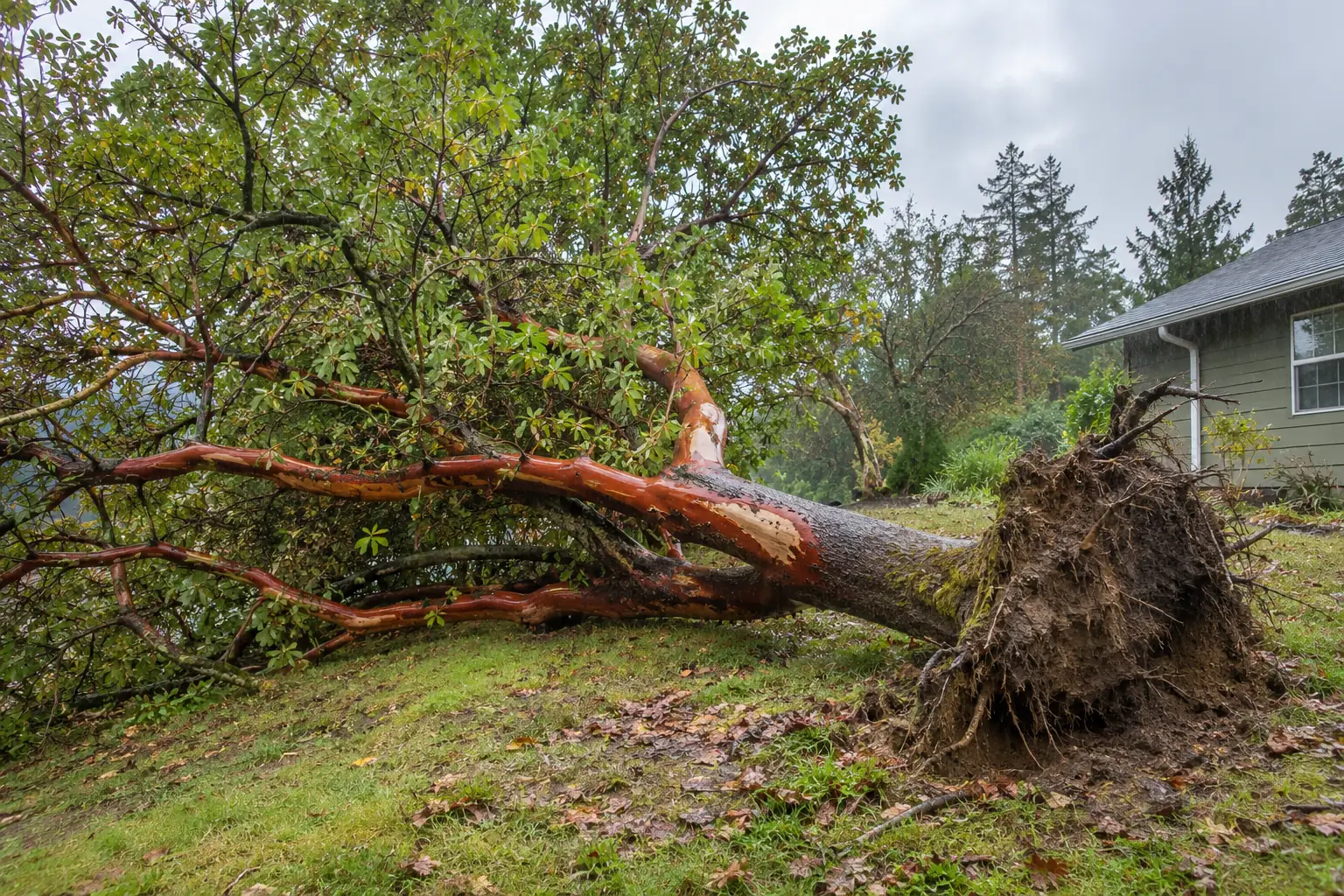
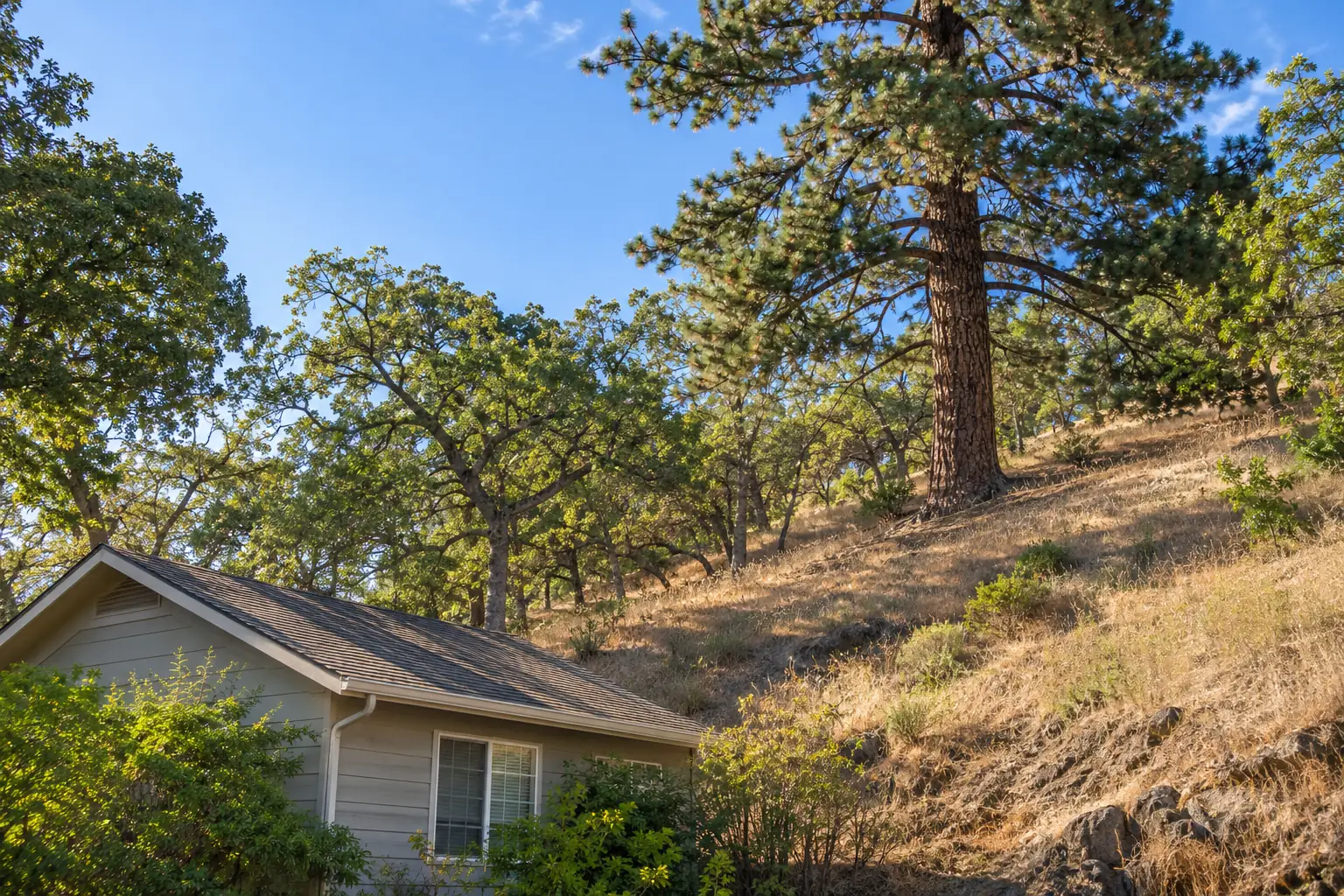
Hillside lots. On a slope, a trunk can roll or slide once it is cut free. The company may need to anchor sections and lower them on ropes instead of dropping them. Trucks may have to park above or below the house. Read more in the hillside tree removal guide.
Lots along the Rogue River. City code keeps vegetation and tree cover within 75 feet of the top of the Rogue River bank, with limited exceptions (Gold Hill Municipal Code, Chapter 17.49). A tree that has fallen on your house still needs to come off your house. What is less clear is how much standing growth near the bank can be cleared during the cleanup. Ask the city before anything beyond the fallen tree is cut. The Gold Hill tree rules guide has the details.
Small lots in town. Tight spaces between houses, fences and sheds mean more cutting in small pieces and more hand carrying. Expect a slower job.
Rural acreage. Outside city limits, long gravel drives and gates can be the bottleneck. Tell the company about weight limits on a bridge or culvert and about soft ground after rain.
Wind, snow and fallen trees in the Rogue Valley
Most tree emergencies here follow wind or heavy, wet snow. The National Weather Service office in Medford issues the watches and warnings for this area at weather.gov/mfr. Its February 2019 climate summary described heavy, wet snow that brought down thousands of trees in the Umpqua Basin to the north. The same summary reported 4.1 inches of snow at the Medford airport late that month.
Wet snow loads a tree's crown with weight it was not built to carry, and wide-spreading oaks and evergreen conifers can both lose large limbs. Before a forecast storm, look at the trees over your roof and driveway. A limb that is already cracked is the one most likely to come down.
Insurance after a tree falls
Many homeowner policies help pay to remove a tree that has fallen on a covered structure, but terms vary, so confirm with your insurer. Some policies treat a tree that fell in the yard without hitting anything differently. Report the claim early and keep every receipt.
Useful things to have ready:
- Photos taken before any cutting started.
- The company's written estimate and, later, its invoice.
- Notes on when the tree fell and what the weather was doing.
The company you are connected with is the one to ask about written estimates for an adjuster. Your insurer is the one to ask about what is covered.
Fire season and emergency cutting
During fire season, saw use on and near forestland in Jackson County follows the Oregon Department of Forestry's daily fire danger level. ODF's 2026 regulated closure proclamation for the Southwest Oregon District bans power saws during extreme fire danger and limits their hours at moderate and high danger. It also requires a shovel, a fire extinguisher and a one-hour fire watch for each saw. A tree company working in summer will plan around those rules. The ODF proclamation also allows the State Forester to approve a waiver in writing. See the fire season tree work guide for the full schedule.
Frequently asked questions
Can I call this service in the middle of the night?
You can dial (541) 855-3080 when the tree comes down, but nobody here can promise that the phone is picked up after hours or how soon anyone could reach you. Your call rings through to a single independent tree company, and whether and when it comes is that company's decision. If no one answers, leave your address and say what the tree has landed on. For anyone hurt or trapped, or any wire, call 911 first.
Who pays for emergency tree removal in Gold Hill?
You pay the tree company directly for the work, at the price you agree to. The call to this service is free. If the tree hit a covered structure, your homeowner policy may help, so check with your insurer.
What if the tree came from my neighbor's yard?
Take photos, tell your neighbor, and report it to your own insurer. Who pays depends on your policies and the facts, so ask your insurer. The tree company can still make the site safe while that is sorted out.
Should I cut the tree off my roof myself?
Leave that to the tree company. A trunk resting on a roof is often under tension and can move when cut. Leave it in place, keep people out from under it, and let the tree company take the weight off in controlled pieces.
Can the tree company remove a tree that is touching a power line?
Not until Pacific Power has made the line safe. Hold everyone 35 feet or farther from it, phone 911, and after that phone 1-877-508-5088 to report the line. The tree company can work once the utility says it is clear.